
Introduction
When people think of Nigeria’s natural resources, oil dominates the conversation. But beyond petroleum lies a vast, largely underdeveloped mining sector with the potential to diversify the economy, create jobs, and drive long-term growth. From gold and limestone to tin, columbite, and rare earth elements, Nigeria’s solid minerals industry is quietly re-emerging as a strategic pillar for the country’s future.
Brief overview of Nigeria’s mining sector
Nigeria is richly endowed with over 40 commercially viable minerals spread across the country. Key resources include:
- gold (North-West and South-West regions);
- tin and columbite (historically mined on the Jos Plateau);
- rare earth elements (REEs) (increasingly important for modern technologies);
- iron ore (notably in Kogi State);
- barite and gypsum (used in drilling and construction); and
- limestone (widely used in cement production).
Historically, mining was a major contributor to Nigeria’s economy before the oil boom of the 1970s. Nigeria was one of the largest global tin producers between 1900 and the 1950s. Since the oil boom, the mining sector has been overshadowed—but recent reforms are aiming to reverse that trend. Historically, the sector contributed to less than 1% of GDP, although recent data suggests improvement to about 1.8% by 2025, reflecting renewed policy attention and investment.
Tenement’s current involvement
Tenement was fortunate to travel to Jos earlier this year to evaluate a potential tin project. The energy and positive attitude of the Nigerian representatives towards the local mining development was palpable. No effort was spared to provide the information we required for our assessment. To the extent that the first ever Nigerian Geological Survey Bulletin (No. I), issued in 1921 entitled The Geology of the Plateau Tin Fields was sourced from the British Geological Survey, along with its associated maps.
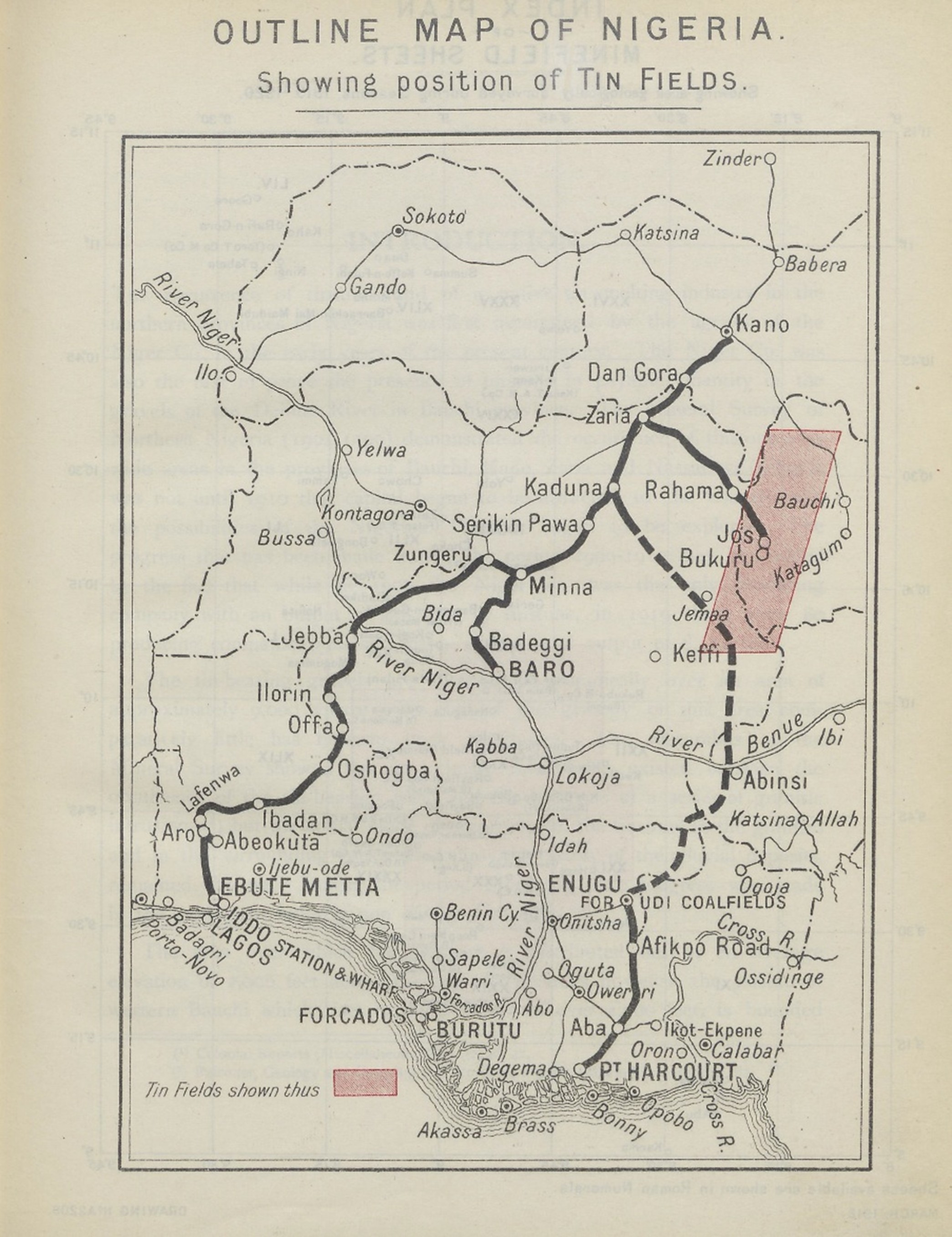
Reading this report has brought about a new respect for the geological fraternity at the turn of the century. The level of detail, technical knowhow and geological interpretations are astounding – putting us all to shame in this era of easy access to information and artificial intelligence! As one of my colleagues commented, “when you walk or ride a horse you see so much more!”
Source: Bulletin No.1: The Geology of the Plateau Tin Fields. By J. D. Falconer. Bulletin I, Geological Survey of Nigeria, pp. 55, with 10 plates and a coloured geological map. Published by the Nigerian Government, 1921
Key Challenges Facing the Industry
- Infrastructure deficits - Mining operations require reliable roads, rail, and power. In many mineral-rich regions, these are limited or underdeveloped. With reference to exploration, internationally accredited assay laboratories are lacking in-country and samples need to be shipped to other West African countries for preparation and analysis, adding significantly to exploration costs.
- Regulatory and policy issues - While Nigeria has made progress with mining reforms, inconsistent implementation and bureaucratic delays can discourage investment. The Nigerian government’s Roadmap for Solid Minerals in 2016 aimed to increase the sector’s contribution to GDP to 10% by 2026. Although this has not been achieved, recently introduced reforms aimed at reviving the sector, include:
- The Minerals and Mining Act (2007, building on earlier laws)
- Strengthening of regulatory frameworks
- Privatization of state-owned mining assets since 1999
- Digitalization of mining cadastre systems
- Incentives such as tax holidays and export grants
- Formalization of artisanal miners through cooperatives
Unfortunately, the cadastre system, it is not yet fully automated and searches cannot be done via the website.
- Illegal mining - Unregulated mining leads to revenue loss, environmental degradation, and safety risks.
- Environmental concerns - Poorly managed mining—especially artisanal operations—can result in land degradation, water pollution, and health hazards. Mining in Nigeria comes with a relatively strict environmental framework on paper—though enforcement can vary. EIAs, EMPs and rehabilitation and closure plans are all mandatory.
- Security concerns - Several mineral rich areas in the Northern region have been liberated from the occupation of terrorist groups and insurgency. However, communal and religious conflicts occur intermittently in the middle belt region. Security concerns are therefore expected to abate overtime given the efforts of the Federal Government of Nigeria.
- Access to finance - Mining is capital-intensive, and local operators often struggle to secure funding for exploration and development. Although the suite of minerals on offer in Nigeria, in particular critical minerals such as lithium and REEs, is attracting renewed international interest.
Nigeria’s future in mining goes far beyond oil. By unlocking its solid minerals sector, the country can diversify its economy, create sustainable jobs, and position itself as a key player in global mineral supply chains. The opportunity is clear—the challenge lies in execution.
The Ministry of Solid Mineral Development of Nigeria in partnership with the Miners Association of Nigeria, PwC Nigeria, and VUKA Group is hosting the 11th edition of the Nigerian Mining Week 2026 in Abuja between 12 – 14 October.